Showing posts with label Cameron Mackintosh. Show all posts

Sunday, February 21, 2016

The Various Mediums of Mary Poppins

BOOKS

The Mary Poppins musical was adapted from the first three of the eight books in P.L. Travers's series


Mary Poppins, published 1934

The first book introduces the Banks family from Number Seventeen Cherry Tree Lane, London, consisting of Mr. and Mrs. Banks; their children Jane and Michael; and baby twins John and Barbara. When the children's nanny, Katie Nana, storms out in a huff, Mary Poppins arrives at their home, complete with her traveling carpetbag, blown in by a very strong wind. She accepts the job, and the children soon learn that their nanny, though she is stern, vain, and usually cross, has a magical touch that makes her wonderful. Among the things Jane and Michael experience are a tea party on a ceiling with Mr. Wigg, a trip around the world with a compass, the purchase of gingerbread stars from the extremely old Mrs. Corry, a meeting with the Bird Woman, a birthday party at the zoo among the animals, and a Christmas shopping trip with a star named Mafia from the Pleiades of the Taurus constellation. In the end, Mary Poppins is satisfied with the work she has done with the Banks family, and the West Wind carries her away. 


Original and revised versions of the "Bad Tuesday" chapter


Mary Poppins contained a version of the chapter "Bad Tuesday" in which Mary and the children use a compass to visit places all over the world in a remarkably short period of time. The original story in the 1934 edition contained a variety of cultural and ethnic types of Chinese, Eskimo, sub-Saharan Africans, and Native Americans; Travers responded to criticism that the picture given was too simple by revising the chapter in 1981 to include animal representatives instead of people. At the same time, original illustrator Mary Shepard altered the accompanying drawing of the compass to show a polar bear at the north, a macaw at the south, a panda at the east, and a dolphin at the west.


Mary Poppins Comes Back, published 1935

Nothing has been right since Mary Poppins left Number Seventeen Cherry Tree Lane. One day, when Mrs. Banks sends the children out to the park, Michael flies his kite up into the clouds. Everyone is surprised when it comes down bringing Mary Poppins as a passenger, who returns to the Banks home and takes charge of the children once again. This time, Jane and Michael meet the fearsome Miss Andrew, experience an upside-down tea party, and visit a circus in the sky. As in Mary Poppins, Mary leaves at the end, but this time with a "return ticket, just in case" she needs to return.


Mary Poppins Opens the Door, published 1943

When Mary last left the Banks children in Cherry Tree Lane, she took a "return ticket, just in case." In the third book, she returns to the park in front of Cherry Tree Lane the way she came, falling with fireworks. Once again she takes up nanny duties in the Banks household and leads Jane, Michael, John, and Barbara on various adventures. This time, they visit her cousin Fred Twigley, befriend a statue that has come to life, go riding on peppermint horses, and experience a garden party under the sea.


Mary Poppins in the Park, published 1952

This fourth book contains six adventures of the Banks children with Mary Poppins during their outings in the park along Cherry Tree Lane. Chronologically the events in this book occurred during the second or third book (Mary Poppins Comes Back and Mary Poppins Opens the Door respectively). Among the adventures they experience are a tea party with the people who live under the dandelions, a visit to cats on a different planet, and a Halloween dance party with their shadows.


Mary Poppins From A to Z, published 1962

Twenty-six vignettes (one for each letter of the alphabet) weave unexpected tales of Mary Poppins, the Banks children, and other characters from Travers's previous novels. Each vignette is filled with fun and unusual words that start with the featured letter.


Mary Poppins in the Kitchen, published 1975

Mary Poppins comes to the rescue when the Banks's family cook has to go on an unexpected leave, teaching the young Banks children the basics of cooking in the process. The book includes recipes.


Mary Poppins in Cherry Tree Lane, published 1982

Mary Poppins takes the Banks children on yet another memorable adventure, this time on the magical Midsummer's Eve. All kinds of strange things can happen, and even mythical figures can descend from the heavens. At the back of the book is a list of the herbs that are mentioned in the story, with their botanical, local and Latin names.


Mary Poppins and the House Next Door, published 1988

The residents of Cherry Tree Lane are distressed to learn that their beloved Number Eighteen, an empty house for which each neighbour has created an imaginary, wished-for tenant, is about to be occupied by Mr. Banks's childhood governess, Miss Andrew, otherwise known as the Holy Terror. Her dreaded arrival brings a pleasant surprise as well, for Luti, a boy from the South Seas, has accompanied her as both servant and student. Delighted by the prospect of a new friend, Jane and Michael are frustrated by the restrictions that the hypochondriacal Miss Andrew has placed on Luti, who grows more and more homesick for his family and tropical surroundings. When the call in his heart to return home becomes more than he can bear, it is Mary Poppins who makes the trip possible by means of a visit to the Man in the Moon.


Due to the series' popularity, there were several adaptations of the books to various media:


Studio One: The character was first brought to life in an early television play telecast live in 1949 by CBS television, as part of their anthology series Studio One. She was played by character actress Mary Wickes, in a performance that may have been noticeably closer to what P. L. Travers envisioned. E.G. Marshall portrayed Mr. Banks and future Lassie child star Tommy Rettig played Michael. David Opatoshu played Bert, who was a Match Man (a seller of matches) in this version. Apparently, no effort was made to disguise the fact that these actors were American.

1964 Film:
Mary Poppins was made into a film based on the first four books in the series by Walt Disney Productions in 1964. According to the 40th anniversary DVD release of the film in 2004, Walt Disney first attempted to purchase the film rights to Mary Poppins from P. L. Travers as early as 1938, but was rebuffed because Travers did not believe a film version of her books would do justice to her creation and did not want an animated cartoon based on it. Disney finally succeeded in 1961, although Travers demanded and got script approval rights.
The relationship between Travers and Disney is detailed in Mary Poppins She Wrote, a biography of Travers, by Valerie Lawson, published by Aurum Press in the United Kingdom. The relationship is also the subject of the 2013 Disney film Saving Mr. Banks.
The process of planning the film and composing the songs took about two years. Songs in the film are by the Sherman Brothers. Mary Poppins is played by British actress Julie Andrews. Disney cast Dick Van Dyke in the key supporting role of Bert. The Banks children were played by Karen Dotrice and Matthew Garber. George and Winifred Banks were played by David Tomlinson and Glynis Johns. The film features a mix of adventures and episodes taken from each of the existing novels, and new events, created for it. In notable differences from the original novels, the film does not include the characters John, Barbara or Annabel Banks, and has Mary Poppins herself characterized as noticeably kinder.
The film received widespread acclaim from critics and audiences, and was nominated for the Academy Award for Best Picture with Julie Andrews winning the Academy Award for Best Actress for her performance as Mary Poppins. The film won an additional four Oscars for Best Original Song ("Chim Chim Cher-ee"), Best Film Editing, Best Visual Effects and Best Original Score.
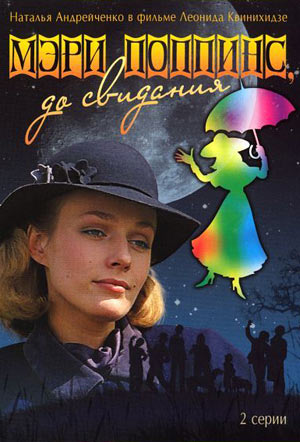
1983 Film:
In 1983, the story was adapted by the Soviet Union's Mosfilm studios into the Russian-language TV musical film Мэри Поппинс, до свидания! (Mary Poppins, Goodbye), starring Natalya Andreychenko (acting) and Tatyana Voronina (singing) as Mary Poppins, Albert Filozov as George Banks and Oleg Tabakov as Miss Andrew.


Here is a link to part 1 of  Поппинс, до свидания!
(You're welcome)

And part 2 of  Поппинс, до свидания!
(You're welcome...again!)


2004 Musical:
Author P. L. Travers resisted selling the stage rights to the Mary Poppins stories for many years, as a result of her dislike of the 1964 film version, and her perception of being treated discourteously by Walt Disney at the film's premiere. Travers eventually agreed to sell the stage rights after being approached by London theatre producer Cameron Mackintosh. She acquiesced on the condition (expressed in her will) that only English-born writers – and no Americans, particularly anyone involved with the film production – were to be directly involved in the creative process of the stage musical.

The world premiere of the stage adaptation of Mary Poppins took place at the Bristol Hippodrome in the United Kingdom in September 2004. The production then moved to the Prince Edward Theatre in London's West End on December 15, 2004, where it ran for three years before closing in January 2008. The show transferred to a UK national tour, and a number of international versions were staged, including a long Broadway run in New York City.

BBC Radio:
On 31 May 2010 BBC Radio 7 broadcast a one-hour dramatization combining several of the adventures into one drama, starring Juliet Stevenson as Mary Poppins. This production has been rebroadcast several times on BBC Radio 4 Extra.

2014 Tim Burton Hoaxes
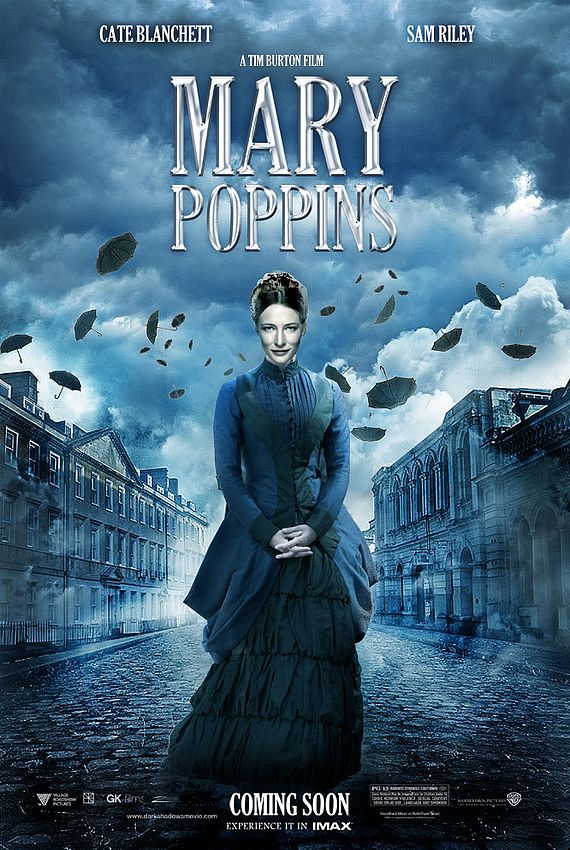
In both March and October 2014, there were rumors circulating that director Tim Burton was set to helm a new version of the story, first with frequent collaborators Helena Bonham Carter and Johnny Depp, and later on with Cate Blanchett in the title role, alongside Sam Riley. There was even a poster made, with Blanchett in period dress against a Victorian city with umbrellas falling from the sky. However, both of these were subsequently debunked as total hoaxes by several news outlets.
Unnamed 2015 Mary Poppins Film
On September 14, 2015, Disney announced a new Mary Poppins film was to be made, with a new plot and new songs. The film is going to be directed by Rob Marshall and written by David Magee. New songs will be composed by Marc Shaiman and Scott Wittman, who have both already gotten support from Richard Sherman, who created some of the iconic songs in the original Mary Poppins. Though the film will not be a reboot or remake of the original 1964 film, Mary Poppins will revisit the Banks Children from the first film. It will be loosely based on the other 7 Mary Poppins books by P. L. Travers and expand beyond those. The film will be set 20 years after the original film takes place. The name of the actress who will succeed Julie Andrews is currently unknown.

_____________________________________________________________
Below is an article written by Michael Ribbeck, Chief Reporter at the Bristol Post, about why generation after generation has "fallen in love with nanny"


Saturday, January 30, 2016

The Life of P.L. Travers

THE AUTHOR, THE STORYTELLER, THE MASTERMIND

Born Helen Lyndon Goff in Australia in 1899, P.L. Travers led a life cloaked in mystery. Even after her death in 1996, the details of her past were unclear. An obituary in the Guardian stated that she was the granddaughter of the premier of Queensland; another in the New York Times described her as the daughter of a sugar planter. While neither of these details are exactly true, you can hardly blame the writers for poor fact checking. Travers had a tendency to bend her life story and make it more attractive, a trait she likely inherited from her father, Travers Robert Goff. He also liked to reinvent his life story; not even his wife was privy to the truth about his past. Goff was a heavy drinker. He spent many evenings spinning stories of a fairytale-like childhood spent in Ireland, though he was actually born in England. Lyndon, as P.L.’s family called her, would spend her life chasing her father’s fantasies. Eventually his myths melded with her own version of the truth to create a personal history that was part reality, part fiction. In her early twenties Lyndon pursued an acting career, changing her name to Pamela and adopting her father’s first name as her last—Pamela Lyndon Travers. It sounded more romantic, more melodic. She later moved to London as a journalist, adopting the pen name P.L. Travers. Further veils were cast, blurring the truth of her history as Pamela invented a new life that seemed much more exciting.

Like the magical nanny she created, P.L. Travers never explained. Throughout her career, people often asked her where the idea for Mary Poppins came from, but she never really told. She believed in mystery, mythology, and folk tales - she believed in questions, not answers. For P.L. Travers, life was a never-ending quest for the truth. One night when Helen was ten, she was left in charge of her two younger siblings during a violent thunderstorm; their mother had walked into the storm, distraught, and they didn't know if she would return. To comfort the younger children, Helen began to weave intricate and magical stories about an enchanted horse, allowing the children to fill in the blanks of the tale.

Although she entered her teens wanting to be an actress and a dancer, Helen soon realized that writing held more power for her. She loved to express herself through storytelling. In February of 1924 she left for London, England, the home of poets, playwrights, and famous storytellers. "There, at last," she said, "I was where I wanted to be" (as quoted in Mary Poppins, She Wrote: The Life of P.L. Travers).

While in London, she wrote for Australian newspapers, describing her adventures abroad. She soon met the poet George William Russell, nicknamed AE, who became a close friend and mentor. He told her that she had a "dangerous brilliance." It was Russell who introduced her to the inner meaning of fairy tales and mythology and, in a moment that would change her life, suggested that she write about a witch. Something about a magical teacher - a combination wise old woman and fairy godmother - appealed to Travers. She took all of her experience and imagination and poured then into a solitary figure, blown into London by a mysterious wind.

In 1926, Travers had written the first Mary Poppins story, Mary Poppins and the Match Man, about a young Mary Poppins meeting Bert the Match Man for an afternoon tea in one of his sidewalk chalk drawings. She built on that original story, creating a world around her mysterious nanny that combined magic and ordinary life. Who is Mary Poppins? Travers' biographer Valerie Lawson wrote, "The original Mary Poppins was not cheery at all. She was tart, and sharp, rude, plain, and vain. That was her charm; that - and her mystery." Mary Poppins, published in 1934 was very popular, and Travers began writing a series of books about the family who lived at No. 17, Cherry Tree Lane.
 
The first book became an international phenomenon and eventually found its way into the hands of Walt Disney. Disney himself was delighted by the book and became determined to make it into a movie. This did not prove to be an easy task. After nearly 20 years of persuasion, Travers finally agreed to sign over the rights to the books, and Julie Andrews and Dick Van Dyke became the Mary Poppins and Bert that so many fell in love with.

The movie became a sensation all its own; it was nominated for 13 academy awards and won 5. The movie cemented Mary's place in the imaginations of countless children and adults. However, P.L. Travers felt that Disney had not stayed true to her books, and walked out of the film premiere in tears. Having been so upset by the film adaptation, Travers was very hesitant when Cameron Mackintosh approached her about turning her books into a musical. She acquiesced on the condition (expressed in her will) that only English-born writers – and no Americans, particularly anyone involved with the film production– were to be directly involved in the creative process of the stage musical. Ultimately, she was again convinced after Mackintosh agreed that no one involved in the creation of the movie would be involved in the making of the stage show. The Mary Poppins musical opened in England in 2004.

Throughout her life, Travers explored the connections between life and storytelling. Fairy tales, she wrote, "live in us, endlessly growing, repeating their themes ringing like great bells. If we forget them, still they are not lost. They go underground, like secret rivers and emerge the brighter for their dark journey." In Mary Poppins Opens the Door, she writes of a mystical crack in the fabric of reality that opens between New Year's Eve and New Year's Day in which all the fairy tale characters come out to play.

"When I sat down to write Mary Poppins or any of the other books, I did not know children would read them. I’m sure there must be a field of 'children’s literature'—I hear about it so often—but sometimes I wonder if it isn’t a label created by publishers and booksellers who also have the impossible presumption to put on books such notes as 'from five to seven' or 'from nine to twelve.' How can they know when a book will appeal to such and such an age?

I certainly had no specific child in mind when I wrote Mary Poppins. […] But I suppose if there is something in my books that appeals to children, it is the result of my not having to go back to my childhood; I can, as it were, turn aside and consult it (James Joyce once wrote, 'My childhood bends beside me'). If we’re completely honest, not sentimental or nostalgic, we have no idea where childhood ends and maturity begins. It is one unending thread, not a life chopped up into sections out of touch with one another.

Once, when Maurice Sendak was being interviewed on television a little after the success of Where the Wild Things Are, he was asked the usual questions: Do you have children? Do you like children? After a pause, he said with simple dignity: 'I was a child.' That says it all.

But don’t let me leave you with the impression that I am ungrateful to children. They have stolen much of the world’s treasure and magic in the literature they have appropriated for themselves. Think, for example, of the myths or Grimm’s fairy tales—none of which were written especially for them—this ancestral literature handed down by the folk. And so despite publishers’ labels and my own protestations about not writing especially for them, I am grateful that children have included my books in their treasure trove."


P.L. Travers dies in 1996 at the age of 96. Her journey was over, but in many ways it had begun. At the first day of rehearsal for Mary Poppins, Cameron Mackintosh said to the company, "I'm sure Pamela Travers is here, today, in spirit! And you can be sure she has plenty of notes for us already!"


"Anything can happen if you let it
Life is out there waiting, So go and get it"

- The Ensemble