Showing posts with label Musical. Show all posts

Tuesday, March 8, 2016

The International Phonetic Alphabet

IPA Tutorial: Lesson 1

Just what is the International Phonetic Alphabet (or IPA)?  I will use the IPA on this blog and you will hear it used on a number of our accent training resources. You will see it used on countless other linguistics websites as well.
If you have no idea what I’m talking about, take a look at this sample:
wʌt ɪz ði aɪ pi eɪ
You may have seen this kind of writing in the pronunciation section of a dictionary definition.  As you can see from the snippet above, the IPA looks like normal English writing, but with some bizarre letters thrown in.
So what is this weird “alphabet” and why is it so important when studying language?

The International Phonetic Alphabet in a Nutshell

The International Phonetic Alphabet is like any alphabet, except that, where most alphabets form the words of a language, the IPA represents the sounds of a language.  Any language, in fact:  the IPA can represent nearly any vowel or consonant made by humans.
This guide is not designed to explain every nuance of the IPA. Rather, I am going to give you the information you need to start using the IPA.  The IPA is like a language:  just as you don’t need to memorize every word in the dictionary to use English, you don’t need to know every single symbol in the IPA to starting using it.
But enough introduction. Let’s get started!

How Are Vowels Made?

For the first lesson of our tutorial of the International Phonetic Alphabet, we’re going to take a look at the vowel sounds.  Before we look at the vowel symbols of the IPA, it helps to know a bit about how vowels are made.

How Humans create Vowel Sounds

Let’s do a little experiment. Make a couple of vowel sounds, like the “ah” in the word “father,” and the “eee” in the word “feet.”  Make any combination of vowels.  It doesn’t matter what they are.
You may notice something when you make these sounds. Your tongue is moving into a lot of different parts of the mouth to create them. That is because vowels are mostly created by the tongue being in a particular position.
For instance, to make the long “eee” sound, I move the tip of my tongue to the topmost, front-most part of my mouth. To make the long “ah” sound I do the opposite: I keep my tongue at the bottom of my mouth.
This is a simple explanation of the process. Most people pronounce vowels using many parts of the vocal apparatus, such as the lips and the jaw. But for the time being, the tongue position is the important thing to understand. If you raise your tongue toward the roof of the mouth, you create one sound; if it’s pushed toward the front of the mouth it creates another sound, etc.
Got it? Okay.  Right now you’re probably asking, “weren’t we supposed to learn some crazy alphabet?”  Don’t worry.  Now we’re getting to the good stuff!

How the IPA Represents Vowels

Okay. We’ve now established that tongue position is important for creating vowel sounds.
So how does the International Phonetic Alphabet represent this tongue action? To answer this question, let’s take a look at the standard IPA chart for vowels:
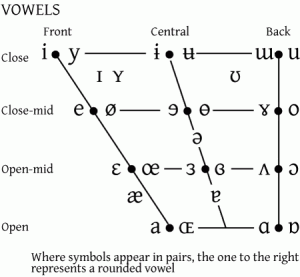
International Phonetic Alphabet Vowel Chart
Above you’ll see large number of symbols, some of them recognizable (like i) and others which look like gobblety-gook (like ɞ). Don’t worry about what these symbols mean for now.  And don’t worry about any of the text on the chart.
What’s important about this chart is the where each symbol is placed in relation to the other symbols. The rule of thumb for this chart is as follows:
The vowel symbols on the IPA vowel chart are in the position where the tongue is placed when creating a vowel.

Let’s break this down with some examples:
The IPA symbol [i] represents the vowel in American English “feet.” This vowel is pronounced with the tongue high and toward the front. The IPA symbol [ɑ], the vowel in “father,” has the tongue low and to the back. And the IPA symbol [u] (the vowel in American English “goose“) has the tongue high in the mouth and pulled toward the back. Each of these symbols appear on the chart above in about the position that you have to move your tongue to produce them.
But this doesn’t explain all of the symbols in the diagram, does it?

Rounded and Unrounded Vowels in the International Phonetic Alphabet

You will notice that most “positions” in the IPA chart above have two symbols next to each other. The symbol on the left is for an unrounded vowel, meaning that the lips aren’t rounded when you pronounce the sound. The symbol on the right of these positions is the rounded version, meaning the lips are rounded when you pronounce the sound.
So, from the IPA chart above, we can deduce the following:
/y/, /u/, /o/ and /ɒ/ are all examples of rounded vowels.
/i/, /ɛ/, /ɑ/, and /a/ are all examples of unrounded vowels.
To clarify, a rounded vowel is a vowel like the “oo” in “room,” while an unrounded vowel might be the “ee” in “fee.”  It’s pretty simple principle, really: you will notice that your lips round slightly as you make some vowel sounds, and stay unrounded while making others.

IPA’s “Stand Alone” Vowels

Scroll back up to the IPA chart and take a look at it.  I’ll wait down here.
You back? Good. You’ll notice on the IPA Chart that there are several vowels that do not appear in pairs. These vowels are:  /ʊ/, /ə/, /æ/ and /ɐ/.  /ʊ/ is a rounded vowel, while the rest of the “stand alone” vowels are unrounded.
The reason these vowels do not come in pairs is that no languages have been identified which have rounded vowel “phonemes” in these positions.  If what I’ve just said completely baffles you, don’t worry.  I’ll explain what “phonemes” are in a later lesson.  For now, what’s important about these vowels is that they operate in the same way the other symbols do on the IPA chart:  they represent where the tongue is place to make them.

The IPA Cheat Sheet

That, more or less, is how the International Phonetic Alphabet creates vowels. Still confused?  I’ve created a handy tool so you can “cheat” your way through reading IPA vowels.  It’s a list of all the symbols of the IPA, and where they occur in English or other languages.


IPA Vowel Symbols

Below is a list of all the vowel symbols of the International Phonetic Alphabet, with an explanation of where you can hear these sounds in different words, dialects and languages.

When you first start reading the IPA, I would recommend consulting this chart as much as possible, as well as looking at the standard IPA chart. It won’t take that long for this weird alphabet to be like second nature.

Basic Vowel Symbols

I’ve going break these symbols up into two groups. The first group are “basic” vowel sounds–these are the sounds you most frequently hear in dialects of the English language.
The second group of vowels are “other” vowels. You will encounter these somewhat less commonly in English.
Symbol English Equivalent

i

The “ee” in “Fleece” in most varieties of English.

ɪ

The “i” in “Kit” in American & most British dialects

e

The “e” in “Bet” in Australian English. Also, the first vowel in the dipthong “face” in American English.

ɛ

The “e” in “Dress” in most American and British dialects.

æ

The “a” in “Cat” in American English.

a

a” in Scottish English “father” or “a” in Italian and Spanish. The first sound in the American English dipthong “kite”

ə

This is the lax, neutral sound in American and British “comma” or “afraid.” It is called the Schwa.

ɑ

The “a” in “father” in most American and British accents. The “o” in “not” in American English

ɒ

The “o” in “lot” in most British dialects. The “ough” in “thought” in Standard American English

ɔ

The “ough” in “Thought” in Standard British and some American accents.

ʌ

The “u” in “Strut” in American English.

o

The “oa” in “Goat” in many Irish Accents. The “ough” in “thought” in many modern British accents. Also, the first vowel in the dipthong “goat” in American English.

ʊ

The vowel in “Foot” or “could” in American English and Standard British English.

u

The vowel in “goose” in American English.

Advanced Vowel Symbols

Then there are the less common, or less commonly-used symbols, which are as follows.
Symbol English Equivalent

y

Like the “ee” in American English “fleece” except with the lips rounded.   Can be heard in a few Scottish dialects in the word “goose.” This is also the “u” in French “tu.”

ʏ

Like the “i” in American English “kit”, except with the lips rounded. Some London and Scottish accents use this to pronounce “Goose.”

ø

Like the “eh” in “bet,” except with the lips rounded. Used in very few English dialects. The “ur” in “nurse” in strong New Zealand accents.

œ

Like the “eh” in “bet,” except with the lips rounded (like [2] above, only with the tongue a bit lower). Used in very few English dialects. Possibly the “ur” in “nurse” in very strong Cockney accents.

ɐ

The “u” in “Strut” in many modern British dialects. This sound is like /a/ described above, except with the tongue very slightly higher in the mouth.

ɜ

A bit like the “ur” in “nurse” in standard british English. The middle of the tongue is placed more or less in the middle of the mouth, and the lips are unrounded.

ɞ

Like /ɜ/ above, except the lips are rounded.

ɘ

Like /ə/ above, except with the tongue very slightly higher in the mouth.

ɵ

Like ɘ above, except with the lips rounded.

ʉ

This is a fairly common sound in English, but requires a bit of explanation. This is the “oo” sound in “goose” as it is pronounced in many London dialects, California English and many Scottish dialects. It is like the “oo” in Standard American “goose,” except with the tongue drawn further forward in the mouth.

ɨ

Like /ʉ/ above, except the lips are not rounded.

ɤ

Like /o/ above except the lips are NOT rounded. Extremely rare in English and most other languages for that matter. A bit like the “u” sound in Japanese.

ɯ

Like /u/ above, except the lips are NOT rounded. Like /ɤ/ above, this is very rare in English and other languages. Again, it’s a bit similar to the “u” in Japanese.

IPA takes a little while to get used to, but once you get it, it’s easy to understand!
All done? Good.  Now let’s move on to the consonants, and Lesson Two of our International Phonetic Alphabet tutorial.

IPA Tutorial: Lesson 2

In the previous lesson of our International Phonetic Alphabet Tutorial, we dealt with the symbols used to represent vowel sounds.  In this lesson, we will examine consonant symbols.

The IPA Consonant Chart

Let’s look at the chart of IPA consonant symbols:
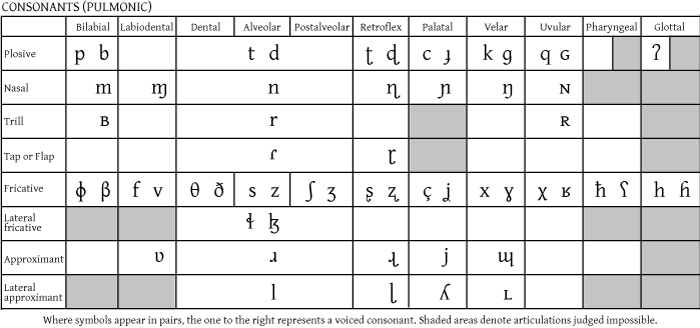
IPA Consonants Chart

More crazy-looking letters, huh?  If you’re overwhelmed, I don’t blame you. As with the vowels, the trick is to learn how this chart works, rather than memorizing every one of these symbols.
Let’s break down the IPA consonant chart so it’s a little more digestible.

Where Consonants Are Produced

You’ll notice that there is a row of phrases at the top of the chart above with brainy words like “bilabial,” “labiodental,” “dental,” etc. You’ll also notice there is a column on the left side of the chart with additional obscure terminology, such as “plosive,” “nasal,” “trill,” etc.  Let’s look at what these words mean.
The row of phrases on the top of the chart refers to the part of the vocal apparatus that is used to create the consonant. ( “Vocal apparatus,” by the way, is just another way of saying any part of the body that use to create speech. The vocal apparatus contains your tongue, your throat, your lungs, and many other body parts.)
So this row of fancy phrases on the chart is actually describing something really simple: the part of the body you use to create that sound.  “Bilabial,” for example, means you make the sound with your lips.
There’s a simple trick here, which you may have already stumbled upon. On the IPA consonant chart, sounds are written out left to right based on how front or back they are created in the mouth.
So for example, the left-most column of consonants is produced at the very front of the mouth (the lips), whereas the right-most column of consonants is produced at the very back of the throat (the glottis).
With this in mind, you can use the chart above to deduce where in the mouth certain symbols are produced.  For example:
/p/, /b/, /m/, /ʙ/, /ɸ/, and /β/ are produced at the front of the mouth (the lips).
/ʔ/, /h/ and /ɦ/ are produced at the very back of the throad (the glottis).
(As usual, don’t worry about what these symbols mean for now.)
But we’ve only talked about the phrases on the top of the consonant chart.  What about the words on the left hand side of the chart?  What I term the consonants “qualities?” What do I mean by “quality?”

Consonant “Quality”

In reality, what I refer to as “Consonant Qualities” is technically called the manner of articulation. But I think “quality” works as shorthand.
To give you an example of what I mean by the “quality” of consonants let’s look at two basic consonants: the “b” in “bed” and the “m” in “man.”  Pronounce both of these sounds, one after the other.  Go ahead.  I’ll wait.
You’ll notice that both of these sound are pronounced with your lips being pressed together. Because of this, they are both grouped together as “bilabial” consonants, which, as I mentioned, is just a fancy word for “sounds that are created with both lips.”
But “m” and “b” are not the same consonant.  That’s because they have different “qualities.” The “m” consonant is a “nasal” consonant, meaning it is pronounced while engaging the nasal cavity.  The “b” sound, however, is a “plosive.”  That means it is pronounced with the lips “popping” or “exploding” with air.  (Other plosives include the “t,” “d” and “k” sounds in English.  All of these “plosive” sounds involve a part of the mouth being closed shut, then released with a sharp burst of air.)
Scroll back up and take a look at the IPA Consonant Chart. To review, the phrases at the top of the chart are the parts of the vocal apparatus used to make these consonants. The phrases on the left-hand side of the chart are the particular quality (or manner of articulation) of these sounds.

Just get familiar with the terminology. And refer to this cheat sheet if there’s a symbol you don’t understand.
Still confused?  Don’t worry.  The truth is, consonant sounds in IPA are a bit more intuitive than the vowels.  In English, with a few exceptions, the consonants in IPA are fairly similar to the way we write them with the normal alphabet!
There are, however, a few consonant that we use for the English language that a little bizarre.  And these are the topic of Lesson Three.

IPA Tutorial: Lesson 3

In the last lesson in our International Alphabet Tutorial, I mentioned that IPA consonant symbols in English are pretty simple.  That’s because IPA symbols used to write consonants in most dialects of English are exactly the same as they are in “regular” writing.
The following symbols are completely self-explanatory:  /p/, /b/, /t/, /d/, /k/, /g/, /m/, /n/, /f/, /v/, /s/, /z/, /h/, /l/. Simple, right?
But there are a few IPA symbols used in English which aren’t quite so cut and dried.

Unusual Consonant Symbols in English

So what are the consonant symbols used in English which are harder to read? They are:
/ɹ/ — This represents the standard (American & British) English “r.” You may wonder why the “r” is upside down.  That’s because /r/ in IPA represents the “trilled r” you hear in Spanish, Italian and Russian.  In most English accents, “r” is pronounced as an “approximant.”  That means that the tongue is in about the same position as with the Spanish “r,” but doesn’t actually touch any part of the mouth.
/j/ — in IPA, /j/ represents the “y” in English “yes.”  Please note that this symbol in IPA is NOT the “j” in words like “juice” or “just.”
/ʃ/ — this represents the “sh” sound in “shoot.”
/ʒ/ — this is the “voiced” version of /ʃ/.  This can be heard in words like “leisure” and “measure.”
/ʧ/ — this is the sound heard in the word “chocolate.” You’ll notice that this is actually a combination of /t/ and /ʃ/.
/ʤ/ — the voiced version of /ʧ/.  You can heard this sound in the words “judge” and “Jack.”
/θ/ — this is the sound you hear in the word “thing.”
/ð/ — this is the voiced version of /θ/.  You can heard it in the words “this,” “the,” and “mother.”
The other IPA symbols for English are really easy.  In fact, if you’re primarily interested in the IPA to learn English dialects, I wouldn’t worry too much about consonants until you have a more advanced understanding of English phonology and phonetics.  Consonants vary a lot less in English than many other languages.
By the way, the reason I’m focusing so much on English sounds here is because I think the best way to learn IPA is to start with your own language.  Hopefully one day there will be a similar tutorial for Spanish or Czech speakers!

A Quick Review

At this point, it’s okay if you’re not grapsing the difference between a fricative and an approximant.  What’s most important is that you understand the following:
1.) The IPA is an alphabet used to write out sounds of human language.
2.) The IPA writes out vowels based on where the tongue is positioned making that vowel.
3.) These positions correspond to the position in the IPA vowel chart.
4.) The IPA’s consonants chart is based on the part of the vocal apparatus used to make consonants and the quality of the consonant (manner of articulation).
If you don’t grasp these points, feel free to go back and re-read any of these lessons. I’m sure you’ll get it!
Our next, and final lesson will deal with a few last minor points.  On to Lesson Four!

IPA Tutorial: Lesson 4

Thus far in this tutorial, we’ve gone over vowel and consonant symbols in the International Phonetic Alphabet. These are the most important parts of learning the IPA. However, there are a few last details we have to go over.

Phonemes and Allophones

I am now going to cover two linguistics terms that are important to fully grasping the IPA.
The first term is “phoneme”.  A phoneme is a single sound in a language that means something different from another sound.  For example, “cat” and “cot” obviously are different words with different meanings.  We know this because the “a” and the “o” in these words are different phonemes.  We pronounce “a” differently from “o” because we don’t want different words to be confused.
But there is a slight problem here, which can be summed up in one word:  “allophones.”Allophones are different ways of pronouncing a single phoneme.
Confused?  Let’s look at an example.
Let’s say somebody from London were to pronounce the words “goose” and “pool.” Even though the “oo” sound is one single phoneme, a Londoner would pronounce the two words with different allophones.  “Goose” is pronounced by most Londoners with a centralized vowel: in the IPA this would probably be written gʉs.  But a Londoner would most likely pronounce “pool” with a back vowel: in IPA this would be written pul.  This is due to some phonological processes that I won’t get into here.  The point is that even though our Londoner pronounces these two words differently, the “oo” is still the same phoneme.
I’ll give you another example:  the word “cut.” Although we think of the “uh” sound in “cut” as a single sound, I’ve probably pronounced this single sound any number of ways: IPA [kʌt], [kɜt], [kət], or [kɐt] depending on how fast I’m speaking, who I’m talking to, and any other number of factors.  But although I may technically say this word in a number of different ways, the “uh” sound in “cut” is still the same phoneme.  The variations in pronunciation are allophones of this phoneme.

Broad vs. Narrow Transcription

So where does this talk of phonemes and allophones come into play when dealing with the International Phonetic Alphabet?
This discussion brings us to an important distinction in the IPA:  “broad transcription“vs. “narrow transcription.” Broad transcription is what we do to write the phonemes of a particular person’s dialect.  Narrow transcription is what we do to write the exact pronunciation of that dialect or a particular speaker of the dialect.
Let’s look at an example.  Suppose I say the sentence “I went to the store and bought a nice bottle of wine.”
If I were to broadly transcribe this sentence in my own dialect (General American), it would read:
/aɪ wɛnt tə ðə stɔɚ ənd bɔt ə naɪs bɑɾɫ əv waɪn/
Never mind if you don’t understand some of the symbols above.  The point is that the transcription above is broad transcription It’s rough estimate of how a General American speaker (like myself) would say this sentence. Now let’s compare this sentence to a narrow transcription of my pronunciation:
/a:ɪ wɛnt tə ðə stɔɚ ən bɑ?t ə næɪs bɑɾɫ ə wa:ɪn/
There are a lot more quirks and variations in the second transcription.  You’ll also notice an interesting marking — [:].  This is an example of “diacritic.” Basically we use little markings like this if we need to express something in IPA that can’t be described with the regular notation.
In the sentence above, for example, I use [:] after [a] to indicate that that vowel is “long,” or pronounced for a longer duration than we normally would.

There are many many diacritics, which are simply too numerous for me to mention here.  I’d recommend that when you see diacritics, you reference this article on Wikipedia — this gives a complete list of IPA diacritics, and you can link to other Wikipedia pages that explain more thoroughly what each diacritic means.  (Yes, Cranky McProfessor, I know that Wikipedia is full of garbage.  But some of their entries for phonetics and phonology topics aren’t bad starting places).

Anyway, I wouldn’t worry about diacritics too much for now.  They aren’t the fundamental building blocks of the IPA.  You’ll learn them bit by bit.

Conclusion

We’ve come to the end of our brief IPA tutorial.  I want to reiterate that this is a very incomplete description of the IPA.  What I’ve attempted to do here is give you the bare minimum information you need to know to understand what is written on this site and other sites that discuss English dialects and languages.
Now use it to have a practically perfect performance!
"if you reach for the stars
all you get are the stars
but we've found a whole new spin
if you reach for the heavens
you get the stars thrown in"

-Mary Poppins


Help with Your British Accents

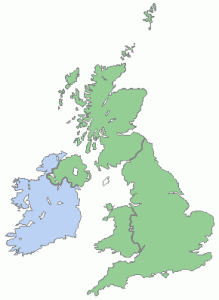
United Kingdom


British Accents

The United Kingdom is probably the most dialect-obsessed nation in the world. With countless accents shaped by thousands of years of history, there are few English-speaking nations with as many varieties of language in such a small space.

(NOTE: This page uses the International Phonetic Alphabet (IPA). For information about this notation, please visit our other blog postings.)

Here is a list of the most important types of British English. While this is not a complete list by any means, it will give you an overview of the accents and dialects most often discussed on this site and elsewhere.

Received Pronunciation

Received Pronunciation is the closest to a “standard accent” that has ever existed in the UK. Although it originally derives from London English, it is non-regional.  You’ve probably heard this accent countless times in Jane Austen adaptations, Merchant Ivory films, and Oscar Wilde plays. It emerged from the 18th- and 19th-Century aristocracy, and has remained the “gold standard” ever since.
Features:
  • Non-rhoticity, meaning the r at the ends of words isn’t prounounced (mother sounds like “muhthuh”).
  • Trap-bath split, meaning that certain a words, like bath, can’t, and dance are pronounced with the broad-a in father. (This differs from most American accents, in which these words are pronounced with the short-a in cat.
  • The vowels tend to be a bit more conservative than other accents in Southern England, which have undergone significant vowel shifting over the past century.
Speech Samples:

Cockney

Cockney is probably the second most famous British accent. It originated in the East End of London, but shares many features with and influences other dialects in that region.
Features:
  • Raised vowel in words like trap and cat so these sounds like “trep” and “cet.”
  • Non-rhoticity: see explanation above under Received Pronunciation, above.
  • Trap-bath split: see explanation above under Received Pronunciation.
  • London vowel shift: The vowel sounds are shifted around so that Cockney “day” sounds is pronounced IPA dæɪ (close to American “die”) and Cockney buy verges near IPA bɒɪ (close to American “boy”).
  • Glottal Stopping: the letter t is pronounced with the back of the throat (glottis) in between vowels; hence better becomes IPA be?ə (sounds to outsiders like “be’uh”).
  • L-vocalization: The l at the end of words often becomes a vowel sound Hence pal can seem to sound like “pow.” (I’ve seen this rendered in IPA as /w/, /o,/ and /ɰ/.)
  • Th-Fronting: The th in words like think or this is pronounced with a more forward consonant depending on the word: thing becomes “fing,” this becomes “dis,” and mother becomes “muhvah.”
Speech Samples:

Estuary English (Southeast British)

Estuary is an accent derived from London English which has achieved a status slightly similar to “General American”  in the US. Features of the accent can be heard around Southeast England, East Anglia, and perhaps further afield.  It is arguably creeping into the Midlands and North.
Features:
  • Similar to Cockney, but in general Estuary speakers do not front th words or raise the vowel in trap. There are few hard-and-fast rules, however.
  • Glottal stoppingof ‘t’ and l-vocalization (see above) are markers of this accent, but there is some debate about their frequency.
Speech Samples:

West Country (Southwest British)

West Country refers to a large swath of accents heard in the South of England, starting about fifty miles West of London and extending to the Welsh border.
Features:
  • Rhoticity, meaning that the letter r is pronounced after vowels. So, for example, whereas somebody from London would pronounce mother as “muthah,” somebody from Bristol would say “mutherrr“. (i.e. the way people pronounce the word in America or Ireland).
  • Otherwise, this is a huge dialect area, so there’s tons of variation.
Speech Samples:

Midlands English

Midlands English is one of the more stigmatized of Englishes. Technically, this can be divided into East Midlands and West Midlands, but I won’t get into the differences between the two just now.  The most famous of these dialects is Brummie (Birmingham English).
Features:
  • The foot-strut merger, meaning that the syllable in foot and could is pronounced with the same syllable as strut and fudge. (IPA ʊ).
  • A system of vowels otherwise vaguely reminiscent of Australian accents, with short i in kit sometimes verging toward IPA kit (“keet”) and extremely open “loose” dipthongs.
  • A variety of unusual vocabulary: some East Midlands dialects still feature a variant of the word “thou!”
Speech samples:

Northern England English

These are the accents and dialect spoken north of the midlands, in cities like Manchester, Leeds, and Liverpool. Related accents also found in rural Yorkshire, although there are some unique dialect features there that I won’t get into now.
Features:
  • The foot-stut merger: (see the Midlands description above).
  • Non-rhoticity, except in some rural areas.
  • The dipthong in words like kite and ride is lengthened so that kite can become something like IPA ka:ɪt (i.e. it sounds a bit like “kaaaait”)
  • Unique vocab includes use of the word mam to mean mother, similar to Irish English.
Speech Samples:

Geordie

Geordie usually refers to both the people and dialect of Newcastle-Upon-Tyne, in Northeast England. The word may also refer to accents and dialects in Northeast England in general. I would classify this as a separate region from the rest of Northern England because it’s so radically different from the language spoken in nearby cities.
Features
  • The foot-stut merger(see the Midlands description above).
  • Non-rhoticity (in the cities at least)
  • The /ai/ dipthong in kite is raised to IPA ɛɪ, so it sounds a bit more like American or Standard British “kate.”
  • The /au/ dipthong in “about” is pronounced IPA u: (that is, “oo”) in strong dialects. Hence bout can sound like “boot.”
Speech Samples:

Welsh English

This refers to the accents and dialects spoken in the country of Wales. The speech of this region is heavily influenced by the Welsh language, which remained more widely spoken in modern times than the other Celtic languages.
Features:
  • Usually non-rhotic.
  • English is generally modelled after Received Pronunciation or related accents, but with many holdovers from the Welsh language.
  • Syllables tend to be very evenly stressed, and the prosody of the accent is often very “musical”.
  • The letter r is often trilled or tapped.
  • Some dialect words imported from the Welsh language.
Speech Samples:

Scottish English

This is the broad definition used to describe English as it is spoken in the country of Scotland. Note that Scottish English is different than Scots, a language derived from Northumbrian Old English that is spoken in Scotland as well. That being said, Scots has a strong influence on how English in Scotland is spoken.
Features:
  • Rhotic, with trilled or tapped r’s.
  • Glottal stopping of the letter t when in between vowels (similar to Cockney and related accents).
  • Monopthongal pronounciations of the /ei/ and /ou/ dipthongs, so that that face becomes IPA fe:s and goat becomes IPA go:t.
Speech Samples:


Acting with an Accent: Standard British

Below are the two links that will bring you to our recording of Dr. David Alan Stern's 1987 instructional lecture. Recordings made possible by Dialect Accent Specialists, Inc.

Video One: 

https://www.youtube.com/watch?v=kjVwc6yjzHY

Video Two: 

https://www.youtube.com/watch?v=KUXnMjoM6Q4


Conclusion

This list is woefully incomplete. I can’t count the smaller dialect areas that aren’t covered here (East Anglia, Urban Cardiff, Cornish English, Northumberland, etc.) However, I’ve attempted to list the accents and dialects you’ll see referenced the most on this blog and elsewhere.

Sunday, February 21, 2016

Something Steely, Unsympathetic, and Cold: A Reconsideration of Mary Poppins


Originally posted on June 22nd, 2010 by Larry Fahey
(http://therumpus.net/2010/06/something-steely-unsympathetic-and-cold-a-reconsideration-of-mary-poppins/)


Something horrible is coming to 17 Cherry Tree Lane, the home of the Banks family. Anyone can see it: clouds are mounting on the horizon, the winds have shifted, the barometer is falling. Their neighbor Admiral Broom (Reginald Owen) warns Mr. Banks (David Tomlinson) that he’s “steering into a nasty piece of weather,” just as Broom had cautioned neighborhood chimney sweep Bert (Dick Van Dyke) that “storm signals are up at number 17.”

But this is no ordinary storm. Mary Poppins (Julie Andrews) is coming.

If the last time you saw Mary Poppins you were under the age of 10, prepare to be startled upon a fresh viewing. I recently watched it with my kids, and like so many things revisited in adulthood, Mary Poppins proved altogether different from my memory.

The first thing you notice is that, despite her reputation as a paragon of patience, understanding, and love, Mary Poppins simply isn’t very pleasant. It’s not clear that we’re even meant to like her. For one thing, she’s highly and relentlessly critical of the children, Michael (Matthew Garber) and Jane (Karen Dotrice) — you slouch, she tells them, you’re slobs, your manners are deplorable, and when you let your mouths hang open you look like fish. She’s also largely humorless, never satisfied with anyone but herself, and terribly vain (she describes herself, quite sincerely, as “practically perfect in every way”). Furthermore, she’s a bully: When a line of nannies congregate outside the Banks’s front door to apply for the job, she conjures a violent windstorm to sweep them away.
Mary Poppins isn’t just rude and egotistical, she’s also faintly sinister. It isn’t simply that director Robert Stevenson (a Disney lifer whose final film, The Shaggy DA, is also surprisingly creepy), and screenwriters Bill Walsh and Don DaGradi (adapting from the P.L. Travers book series) choose a violent, foreboding storm to announce her arrival, although that certainly sets the stage. There is, in Andrews’ performance, something steely, unsympathetic and cold that makes even the magical things she does — sending toys leaping back onto shelves with a snap of her fingers, say, or jumping into a chalk sidewalk drawing — feel a little threatening. It’s not for nothing that this recut trailer works so well.
If we have a pervasive, collective sense of Mary Poppins as the most dreamily agreeable babysitter of all time, it’s presumably because she can perform magic (I suppose looking and sounding like Julie Andrews doesn’t hurt, either). But really, it’s remarkable how much is obscured by the magic and the singing. The children have fun with Mary Poppins, but she allows it only grudgingly. Bert is the real instigator—she only takes the children into the sidewalk drawing after he fails in his attempt to do so (“Why do you always complicate things that are really quite simple?” she scolds Bert), and when they find old Uncle Albert (Ed Wynn) floating helplessly at the ceiling thanks to a fit of giggles, she’s furious at Bert and the children for encouraging him, as if fun and laughter are somehow hazardous. This could be the key scene in the film, in fact. The lightness and giddiness are all things we associate with Mary Poppins. The first time we see her, she’s sitting in a cloud, presumably awaiting her next assignment, and between that and her magic umbrella, she’s strongly identified with the heavens. But on close inspection, none of that feeling really comes from Mary herself, and the fact is that her sensibilities are firmly earthbound. The frivolousness, fun and whimsy of childhood are everywhere in the movie, but only in spite of Mary Poppins who, it seems clear, would just as soon see the children dressed properly in their best Sunday suits, obediently awaiting her next command.

There’s very little on the screen to suggest that Mary Poppins is, or is meant to be, a real character, with feelings, dreams, a past or a future. She doesn’t suffer aspirations or disappointments, only annoyances (and many of those) and smug affirmations of her good sense and rightness, and she doesn’t want anything because she has everything she wants already. The “practically perfect” line is meant as a joke, I suppose, but it’s true: She’s perfectly in charge of the children, perfectly vain, and perfectly self-assured. “I never explain anything,” she haughtily tells Mr. Banks when he demands to know, quite reasonably, why he’s come home to find a small army of chimney sweeps performing a choreographed dance number in his living room. Mary Poppins is a closed circuit, perfectly self-sustaining, a machine without the capacity or need for love, either chaste or romantic (you could spend the entire film watching nothing but the sexual undercurrents between Bert and Mary, although they almost entirely flow from him towards her).

But if Mary isn’t meant to be a person, what is she? If she’s meant to represent something, then what? It’s not warmth or kindness — she makes it quite clear during her initial interview with Mr. Banks that her wages are a matter of great concern to her, and she holds the children at arm’s length. It’s not love, either: at the end of the film, as Mary begins to pack her bag (including her prized possession, a mirror), the children tearfully beg her not to leave, profess their love and ask, “Don’t you love us?” Mary replies, “And what would happen to me, may I ask, if I loved all the children I said goodbye to?” Andrews and the treacly music behind the dialogue do their best to inject a mood of sorrow into the scene, but there’s simply nothing else in the story or Andrews’s performance to support the idea that Mary Poppins cares about them in the least, to suggest that this hasn’t been, in fact, just another job.

By the end of the film, we’re meant to feel that Mary Poppins has taught the children — or more to the point, their parents — a valuable lesson, but it’s hard to say just what it is. Standing on the front step, ready to depart, Mary watches the kids run off to the park with their parents without so much as a goodbye, and her bird-shaped umbrella handle says, “Look at them! You know, they think more of their father than they do of you!” (By this point, it seems perfectly consistent that Mary Poppins has an easier and more natural relationship with an inanimate object than she does with actual people.) “That’s as it should be,” Mary replies, and again, Andrews gives her line readings a Disney touch of sentimentality. But again, because she’s been such a relentlessly unsentimental character, it rings hollow. So have they somehow learned, thanks to Mary’s eye-rolling and grumbling assent to various ill-advised adventures, to love their father, or he to love them? It’s a stretch.

Still, I can’t help but feel that there is some message in the film, even it isn’t the one that everyone seems to hear (in fairness, the steeliness of Mary Poppins hasn’t entirely escaped notice). Maybe I’m giving it too much credit. After all, the early 1960s were a strange, transitional time in American film. The studio system was moribund, and the new Hollywood of independent cinema, maverick directors and raw subject matter were rumbling below the surface, but still a few years from changing movies (John Cassavetes’ Shadows appeared in 1959, but Easy Rider didn’t come along until 1969). With few exceptions, major studio films were bloated and unfocused, designed by committee to make money, not statements.

Nevertheless, you could say that even a high-profile spectacle like Mary Poppins might have a message. After all, Mary represents discipline and, specifically, the idea of giving children less love, or at least what too many parents think of as love—namely, indulgence. What if Mary Poppins, a supernatural being if ever there was one in cinema, is the higher, less familiar idea of boundaries, consistency, and authority? Their parents, and specifically their father, have a strong sense of propriety, but that’s not really the same thing. As I said, Mary doesn’t try very hard to make us or anyone else like her, and maybe that’s the point: Maybe Mary Poppins is meant to suggest that love and indulgence are different things, and that sometimes love looks cold, efficient and decidedly unsentimental. Can a movie made in the 1960s and set in Edwardian England have something to teach 21st century parents? I think it can.

The Socioeconomic Class structure of 1910 England


EDWARDIAN SOCIETY

During our rehearsals for Mary Poppins, we will be having discussions about society in 1910 London and how one's station may have had an impact on his entire life. England was emerging from 60 years of Victorian puritanism, and British society was considered quite "buttoned up." The Edwardian era corresponds to the reign of King Edward VII in Great Britain, whose short-lived governance (1901-1910) followed Victoria's long reign and preceded the modern House of Windsor in England. The "Edwardian" style broadly encompasses the years of 1901 through to 1919. After the reign of Queen Victoria's son, Edward VII, society relaxed a bit and finally began to "undo the top button." Change, however, can be a slow process, and many people clung to the strict mindset and manners of Victorian times.

The beginning of the Twentieth Century experienced tremendous technological and social change. The wonders of the modern world, which had only sprang into being in the 1880s and 1890's brought the first rewards of modern industrialization and mass-produced abundance. It was a time where Britain was at its imperial height and one in three of the world's population were her subjects. On the other side of the Atlantic, Americans were experiencing new-found wealth and indulging in cuisine, fashion, entertainment and travel as never before. Perhaps the Edwardian era was best captured in the Titanic, the grand ocean liner which embodied human progress, opulence, and the excesses of the time.

The Edwardian era is viewed nostalgically and often called the "Gilded Age". In Britain, it was a time of peace: sandwiched between the Boer War (1899-1902) and the First World War which broke out in 1914. In the words of Samuel Hynes, it was a 'leisurely time when women wore picture hats and did not vote, when the rich were not ashamed to live conspicuously, and the sun really never set on the British flag'. It was also a time of great inequality, in which the privileges of the rich were made possible by the labor of their servants, an age when the inequalities of wealth and poverty were starkly delineated and the conventions of class were still rigidly defined - there was a place for everyone and everyone knew their place.

Here is a brief outline to what was going on in Britain from 1901 - 1914

1901
22nd January Death of Queen Victoria, aged 81, after a reign of 63 years. Edward VII succeeds to the throne.
September Taff Vale Judgement, a landmark in the development of the Labor Party. Workers on the Taff Vale Railway took action to gain the right to join a trade union. After the strike was settled, the railway company sought damages from the union for losses incurred during the strike. The House of Lords granted £42,000 plus costs against the union, thereby severely limiting the right to strike.
October Britain's first submarine launched.
December First Nobel Prizes awarded.
1902
January Smallpox outbreak in London
March Cecil Rhodes 'the architect of Empire' dies.
May Boer War ends.
July Arthur Balfour succeeds Salisbury as Conservative Prime Minister.
9th August Coronation of Edward VII, delayed from July because of the King's appendicitis.
Charles Booth's survey of poverty, Life and Labour of the People of London, published. Windsor Castle opened to the public. Beatrix Potter's Peter Rabbit published. Rudyard Kipling's Just So Stories published.
1903
1st January Edward VII proclaimed Emperor of India.
October Formation of the suffragette Women's Social and Political Union (WSPU), by Emmeline and Christabel Pankhurst.
December Marie Curie becomes the first woman to win the Nobel Prize. Wright Brothers make the first successful flight in a petrol-powered airplane.
1904
February War breaks out between Russia and Japan when the Russian fleet attacks at Port Arthur.
April Entente Cordiale signed with France. License plates for cars compulsory.
May Rolls-Royce car manufacturing company formed.
November Figures released reveal that poverty is rising dramatically - 122,000 people in London and 800,000 in England and Wales are in receipt of poor relief, with 250,000 in workhouses.
December J.M. Barrie's Peter Pan, or The Boy Who Wouldn't Grow Up opens in London.
1905
January By popular demand, Arthur Conan Doyle brings his famous detective back from the 'dead' in a new book, The Return of Sherlock Holmes.
April More than 10,000 people perish in an earthquake in Lahore, India.
May Women's Suffrage Bill 'talked out' in Commons.
June Automobile Association founded.
July Einstein's Theory of Relativity proposed.
August Lord Curzon resigns as Viceroy of India.
October Christabel Pankhurst and Annie Kenney arrested: start of the militant phase of the Suffrage movement. Aspirin on sale in Britain.
December Balfour resigns; Henry Campbell-Bannerman invited to form a government. First motorized ambulances for traffic accident victims introduced by London County Council (previously ambulances were used only for people suffering from infectious diseases).
1906
February Liberal landslide at General Election; Labor wins 29 seats. HMS Dreadnought launched. Formation of the Labor Party. Trade Disputes Act overturns Taff Vale Judgement. Free school meals introduced for children in need.
April Vesuvius erupts, killing hundreds. San Francisco earthquake: 800 die. SOS becomes the international distress signal.
1907
April Women can stand for election in county and borough elections and can take the office of mayor.
1908
April Ill-health forces Campbell-Bannerman's resignation: Herbert Asquith succeeds him as Prime Minister. Old Age Pensions introduced for a minority of old people. Coal Mines Regulation Act legislates for a maximum working day of 8 hours underground. Territorial Army founded. By 1914 it had over 250,000 members. England plays the first ever international football match, against Austria - and wins 6-1.
June Edward VII visits Russia. Olympic Games staged in London. National Farmer's Union founded.
December Professor Ernest Rutherford awarded the Nobel Prize for Chemistry for his work on radiation and the nature of the atom. E.M. Forster's Room with a View published.
1909
Labor Exchanges established. Trade Boards Act establishes minimum wage in some of the lowest-paid trades.
July Blériot makes the first cross-Channel flight, taking 43 minutes.
November The House of Lords throws out Lloyd George's 'people's budget' - the 'most radical budget in the nation's history'.
1910
Liberals under Asquith win general election in February and December.
21st May Death of Edward VII; succeeded by George V.
July Dr. Crippen arrested at sea for the murder of his wife, the first criminal suspect to be caught by radio. He was traveling with his mistress Ethel Le Neve, disguised as a boy.
20th August Florence Nightingale dies. Osborne Judgement bans trade unions from funding political activities. Girl Guide movement founded by Baden-Powell and his sister, Agnes.
1911
March Shops Act legislates for 60-hour week and all employees entitled to half-day holiday each week. Payment of MPs (Members of Parliament) introduced.
23rd June George V crowned in Westminster Abbey.
July Agadir crisis, when Germany sent a gunboat to Morocco, fueled Britain's concern about Germany's expansionist aims.
November Balfour resigns as leader of the Conservative Party; succeeded by Andrew Bonar Law.
December George V crowned King Emperor at Delhi Durbar.
Period of industrial unrest 1911 to 1914.
1912
January Captain Scott's expedition reaches the South pole - Amundsen has beaten them. All perish on the return journey.
April The 'unsinkable' Titanic sinks after hitting an iceberg, with the loss of more than 1,500 lives.
May Irish Home Rule Bill introduced.
September Edward Carson organizes the Ulster Volunteers to resist Home Rule for Ireland. British Board of Film Censors established. Royal Flying Corps (precursor of the Royal Air Force) established.
1913
March Cat and Mouse Act introduced in an attempt to deal with the problem of suffragettes' hunger strikes in prison.
June The suffragette Emily Davison throws herself under the King's horse at the Derby and dies from her injuries. The zip fastener patented by a Swedish engineer. Trade Union Act reverses Osborne Judgement.
September Ulster Volunteer Force established. D.H. Lawrence's Sons and Lovers published.
1914
Immigration, already restricted since 1905 Act, further restricted. By 1914 there were over 50,000 women involved in peaceful campaigning to get women the vote.
March Velazquez's Rokeby Venus slashed in the National Gallery by a suffragette with a meat cleaver.
April George Bernard Shaw's Pygmalion opens in London. James Joyce's Dubliners published.
28th June Archduke Franz Ferdinand of Austria assassinated by a Serbian nationalist in Sarajevo.
1st August Germany declares war on Russia and, on the 3rd, France.
4th August Britain declares war on Germany when it violates Belgian neutrality. In the first 18 months of war 2.4 million men signed up voluntarily. A quarter of men of fighting age volunteered in England and Wales. Fighting continues on the Western Front until 11.00am on 11th November 1918. By this time, 772,000 British have been killed, and 1,676, 037 wounded.

CLASS STATUS

Status is a person's position in society, and it changes the way she sees the world, and how others see her. In Edwardian England, status was pretty much set in stone - your position when you were born was the same throughout your life. What Americans would consider "individualism" did not really exist. There was very little thought about moving up to a higher station in life - it was just not done - and so, people comported themselves according to their position in the hierarchy. But your status can be different depending on whom you relate to. For example, Mary Poppins's status is high compared to the children (she is their mentor and caregiver), but Mr. Banks can fire her (she is his employee).

At the beginning of the 20th century, English society was built on the vision that everybody had his place in the ladder of society, and those on the lower rungs served those higher up. During the Edwardian period, British society was divided. The following are the people who might have worked in an upper class or upper middle class English home in 1910.

  • Upper Class: Royalty, the nobility, and the very rich.

  • Upper-middle Class: The wealthy, bankers, lawyers, doctors, merchants, and manufactures.

  • Lower-middle Class: A growing class in early 20th century Britain, consisting  of shop keepers, managers, civil servants and small manufactures.

  • Working Class: Chimney sweeps, farmers, factory workers, shop employees, house servants, clerks.
  • Lower Class: The homeless and destitute were still a grave and growing concern during the Edwardian Era.

THE RISE OF THE NANNY

During the 19th century and into the early 20th century, something unique happened in Great Britain. Rather than raising their children themselves, mothers and fathers from rich and middle-class families handed over their children to special caregivers called "nannies," who were hired to address children's every need from food and education to discipline. As in Mary Poppins, fathers worked while mothers entertained guests and led the staff or servants. Having a nanny became a status symbol; the middle classes hired nannies even if they couldn't afford them.

So why did this happen? During the industrial Revolution of the 18th and 19th centuries, both population and wealth dramatically increased in Great Britain. In 1830, the average English family had six or seven children, and this number was even higher for the wealthy. More children created a need, and more money created the means to hire more servants to watch the children. As Jonathan Gathorne-Hardy in his book The Rise and Fall of the British Nanny writes, "If the rich had anything that needed looking after - whether it was a coat or a child - then there was a servant for it."

As nannies became more and more popular among the wealthy and middle classes, their power in the household increased. The nursery was their kingdom and they ruled it with a firm hand. The nursery was always removed from the rest of the house; many times, as in Mary Poppins, it was on the top floor or near the servants quarters. Children would see their parents for only a short amount of time each day. Nannies controlled the children's clothing, books, food, medicine, and discipline, and so exerted a great deal of influence over the lives and personalities of their charges. (**cough cough George Banks**)

Below are some of the people who might have worked in an upper-class or upper-middle-class English home in 1910. Note that the Banks family has not hired this entire staff of workers for their home - George's position at the bank does not pay enough for them to afford such a staff this large.


EDWARDIAN DRESS AND MANNERS

In the Edwardian era, how one held oneself and moved was in keeping with their social status. The wealthy were obsessed with public appearance, and they took great pains with the way their looked. Much of the desired effect was accomplished with clothing.

In order to achieve the ideal Edwardian body shape, women wore corsets underneath their clothing. Wearing such undergarments affected every movement they made. Because they could not move very quickly or take large steps, women had an air of leisure in the way they strolled. When ladies sat, it was usually on the edge of their seats, since sitting back would make it virtually impossible to get up again. This reinforced the illusion of poise. It also made it extremely difficult to dress without the help of servants. All women wore corsets, even the servants. Servants' clothing, however, was not as weighty as their employer's, since they were expected to cook, scrub, and carry for hours every day. They held themselves up straight and, depending on their status in the hierarchy of servants, could have an elegance of their own, but they also had to be able to complete their duties.


"[The Edwardian lady is] a spectacle which cannot be seen today... she knew how to move and carry herself. She had balance and poise, she had elegance, and she was one hundred percent feminine." - W. Macqueen-Pope, Goodbye Piccadilly 


The hallmark look of the age was the S-shape silhouette. Accomplished with eh S-bend )or swan bill) corset that helped push the hips backward, it enhanced the chest and gave the woman the appearance of leaning forward (A style known as a "pigeon-breast"). In the years preceding 1910, women wore their hair in pompadours, made famous by the "Gibson Girl" (the feminine ideal of beauty portrayed by the satirical pen-and-ink illustrations of illustrator Charles Dana Gibson). By 1910, the hairstyle was more flattened on top and puffed out on the sides with a part in the middle. A lady never went out without her hat, which generally had a large brim in order to protect her skin from the sun. Tanning was shunned, as a pale complexion was the ideal.

For Edwardian men, the three piece suit was the standard. In the upper and middle classes, tailored suits and starched collars were typical, and some men wore modified corsets as well. The tightly tailored suits, along with the well-starched high collard shirts and corsets restricted movement and forced straighter posture. All of this influenced the way Edwardian men carried themselves and gave them an air of importance.They tended to wear more muted colors (black, dark blue, gray), but added to the elegance and formality of their look with elaborate cravats and gloves. Their hair was usually parted in the middle or brushed across their temples - some men even curled their hair. The servants in such households were held to a certain formal dress code, but were still expected to complete their duties in uniform. Working men, such as chimney sweeps, had neither the means or the need for such finery and wore functional clothing to get their jobs done.


For the children of the upper and middle classes, sailor-inspired looks were popular for both boys and girls. Dresses for girls loosely mimicked the "pigeon-breast" appearance in a range of pastel colors.


During the 20th century, the rooftops of London were the chimney sweeps' kingdom. As long as we have heated our homes with fire, there has been a need to clean out chimneys of soot, and the sweeps have always come to the rescue. During the Industrial Revolution of the 18th and 19th centuries, more and more people built tightly packed houses in cities and urban centers - and with houses came chimneys.  In 19th-century England, young boys were employed as chimney sweeps because it was easier for them to get inside the chimney. Many became sick and dies from this difficult work.

The chimney sweeps of London were not restricted by the formality of clothing at all - no starched collars for them! Because they had to crawl around in narrow spaces, climb up chimney flues, and traverse the rooftops, it was necessary that their clothing be functional, allowing them complete freedom of movement. They were more grounded; walked with a looser, easier gait; and never had to worry about how they looked, especially since they spent a lot of time covered in soot.

The phrase "to light a fire under" someone - to make him work faster or harder - comes from the young chimney sweeps. Sometimes a young sweep was too scared to go into a chimney, so his boss would light a fire in the fireplace underneath him! Being a chimney sweep was a dangerous job, but an important one. Dirty chimneys could easily cause fires and back up with deadly smoke.

Eventually, the creation of instruments that would allow someone to sweep the chimney without actually being inside allowed older men like Bert to take over the job. In many places in Great Britain, it's still considered good luck to shake hands with a sweep. Chimney sweeps are sometimes hired for weddings so they can shake hands with the bride and groom before the ceremony. In fact, sweeps today often make more money at weddings than they do cleaning chimneys!
Character sketch of Bert by Bob Crowley

"A FATHER, A MOTHER, A DAUGHTER, A SON
THE THREADS OF THEIR LIVES ARE ALL RAVELLING UNDONE
SOMETHING IS NEEDED TO TWIST THEM AS TIGHT
AS THE STRING YOU MIGHT USE WHEN YOU'RE FLYING A KITE."
- BERT

Saturday, February 20, 2016

Was Mary Poppins a servant... or a Lady?

The following is a an entry from the British Nanny History wordpress blog originally posted on April 21, 2014. (The blog can be found here: https://britishnannyhistory.wordpress.com/blog/)

Was Mary Poppins a servant… or a Lady?

Was Mary Poppins a servant… or a Lady?
Nanny Knows Best author, Katherine Holden, reveals the changing status of the British nanny in this article published by The Lady magazine.
Servant or a ladyIn 1910, when army officer’s wife Joan Kennard was looking for a nanny (children’s nurse) for her two young sons, one of her first considerations was whether or not the nurse should be ‘a lady’. And she was decidedly against the idea. Joan had consulted Mrs Boucher, owner of an agency supplying nannies to the upper and middle classes throughout the early and mid-20th century and, as Joan explained in a letter to her mother, her chief concern was that Mrs Boucher was trying to foist lady nurses on her. She was determined to resist to the last if she could. 

In the end, she was forced to give in as no other suitable applicants appeared. She was reassured, however, by the fact that, although the nurse on offer called herself a lady, as a quiet-looking, middle-aged farmer’s daughter (an occupation on the borderlines of gentility) she would not give them any trouble. 

Lady nurses became increasingly common at the turn of the 20th century as more ‘respectable’ women with limited education needed to work to earn a living. In the big houses they had nursery maids to assist them with childcare, and servants to do the cleaning and washing. 

Finding reliable servants became more difficult as the century progressed, however, resulting in an oversupply of ladies wanting to be children’s nurses but fewer maids available to wait upon them. The ‘trouble’ to which Joan was referring plagued nanny employers throughout the century. This was the lady nurses’ belief that they should not be expected to do any housework. 

Advice columnists tried to clarify the difference between ordinary children’s nurses and lady nurses. In The Lady in September 1905, a correspondent was advised that a lady nurse ‘does not clean her nurseries, nor carry up coals, water or meals’. Yet many employers ignored this advice and informed applicants that, in addition to childcare, they would be doing light or slight housework, or that no other servant was kept. 

Servant or a ladySome advertisements indicated that a lady was either preferred or not objected to, or that applicants should be ladylike. These were coded references to the fact that they might be expected to do some work not normally performed by ladies. 

Most nannies had more humble origins. Employers were particularly keen to have country girls, believed to be healthier and a better influence on the children than girls from the city. While the majority of nannies worked alone or with one other servant, in the bigger houses they started as nursery maids and often worked their way up to become head nurse or nanny. This was a good career move as the status of a head nurse was higher than that of other servants. They had a closer relationship with the family and, if they worked for the aristocracy, might have direct contact with the rich and famous at parties, and also in the drawing room when they brought their charges down to see their parents during children’s hour. 

Annie Turrell, head nurse for the Banks Family at Kingston Lacy in Dorset during the early 1900s, was in this situation. One of seven children, her parents had been farm laborers from Essex living in a cramped cottage, and she moved far away from her childhood home to find work. One of her charges remembered her parading majestically behind the pram with nursery maids in tow, but she left soon afterwards for an even better position. 

Although never considering herself a lady, Annie was employed to look after the young Lord Portarlington, heir to Emo Court in Ireland. Here she was in an enviable position, in sole charge of an only child with a nursery maid and a host of other servants to wait upon her. 

While many families continued to recruit country girls like Annie, concerns were often expressed about the rough manners and values transmitted to upper-class children if they were not looked after by ladies. It was for this reason that in 1892 Emily Ward founded the first nursery-nurse training college, the Norland Institute, which raised the status of nannies into a profession and recruited only the daughters of gentlewomen. 

But, while there was high demand for their services, many mothers felt uncomfortable with this new breed of modern nurse whose social status, like that of the less well educated lady nurses, was rather too near their own. A mother, Joan Bateson, writing in Nursery World magazine in the 1920s, wondered ‘What should we call her? Where ought she to feed? Will she hate your friends, or will she want to know them? If you are smoking, do you offer her a cigarette?’ 

Few women wanted to be servants after the Second World War and many mothers were desperate to find nannies who were willing to muck in with the chores. In correspondence columns, nannies and mothers debated whether or not housework should be included in addition to childcare, and what the job should be called. 

Trying to cope with ‘rations, coupons, housekeeping, sickness, etc’, one mother longed for a ‘jolly, understanding, honest-to-goodness soul who is not too superior’ and asked readers to invent a title for the type of helper she required. 

By the 1950s, advertisers and employment agencies rarely linked the word ‘lady’ to nannies, even in The Lady magazine, and nanny agencies today never mention the word. Yet terms such as ‘quality assured’, ‘fully screened’ and ‘staff of distinction’ suggest that in the 21st century the lady nurse may still not have entirely disappeared. 

Images sourced/copyright: The Lady Magazine.

Nanny Knows Best: The History Of The British Nanny, by Katherine Holden, is published  by The History Press, priced £18.99. http://www.lady.co.uk/people/features/3306-was-mary-poppins-a-servant-or-a-lady